ESP32 IoT Starter Course

Put your projects on the internet. Ten chapters taking the ESP32 from first upload to a complete environment monitor — ... Show more
Instructor
Alpsense
0
0 reviews
  • Description
  • Curriculum
  • Reviews
IMGL9107 copy.jpg

An Arduino project lives on one desk. This course is about what changes when it can talk — when a sensor reading becomes a web page on your phone, a message to a service, or an instruction arriving from the other side of the world.

The ESP32 has WiFi and Bluetooth built into the chip, and far more power than an Uno. Over ten chapters you will get it online, serve a live dashboard from it, publish readings over MQTT, control it remotely, and cut its power consumption enough to run for months on a battery.

What you will build

  • A web server you can open from any phone on your network — no app required
  • A live dashboard that updates itself, fed by a JSON endpoint
  • A client that fetches from public APIs and posts its own readings out
  • An MQTT node that publishes data and accepts commands from anywhere
  • A battery-powered sensor using deep sleep
  • A complete environment monitor that keeps working when the network does not

Before you start

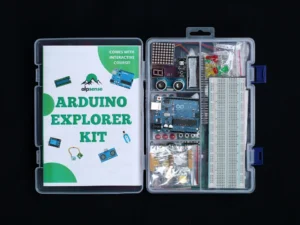
This course assumes you have completed Mastering Arduino Uno or the Arduino Explorer Kit Course, or are otherwise comfortable with sketches, pins, variables and the Serial Monitor. It does not re-teach those.

It does cover, carefully, the ways the ESP32 differs — and the first of those will destroy components if you miss it: the ESP32 runs at 3.3V, and its pins are not 5V tolerant.


Certificate included
Course details
Duration 10 chapters
Lectures 10
Quizzes 5
Level Intermediate
Complete all six sections to finish the course.
Desktop, tablet and mobile
Basic info
A practical introduction to connected devices using the ESP32 — WiFi, web servers, HTTP clients, MQTT and low-power operation.
Course requirements
An ESP32 development board and a USB data cable. A 2.4GHz WiFi network you know the password for — the ESP32 cannot use 5GHz networks. An LDR or potentiometer, LEDs, resistors, breadboard and jumper wires. Prior Arduino experience is assumed.
Intended audience
Students and makers who have completed a beginner Arduino course and want to build connected, internet-capable projects.